Water
What a borehole really costs in inland South Africa
A drilling quote is a rate, not a total. Here is what sits between the two, why the depth is the variable that decides everything, and the sequence that stops you buying the wrong pump.
Pillar 01
Getting it out of the ground, off the roof, and back out of the house clean enough to use twice.
Water independence in South Africa means solving four problems in sequence: getting water out of the ground or off the roof, storing enough of it to bridge dry spells, treating what comes out of the house so it can be used again, and building systems that do not collapse when the municipality does. None of those problems is solved by a single product.
Water is the first constraint on any off-grid or semi-off-grid property, and it is almost always underestimated. People plan solar panels before they have confirmed a reliable water source, and they discover the error the first time a borehole runs dry or a tank runs out in February.
The subject has five moving parts — groundwater, rainwater, greywater, constructed wetlands, and natural pools — and they interact. Greywater fed into a constructed wetland reduces what you need to pump. Rainwater harvested off a large roof reduces dependence on a borehole. A natural pool is part of a water cycle, not a luxury feature. Understanding how the parts connect is more useful than optimising any one of them in isolation.
This pillar covers all five. Each section below orients you to that part of the subject, names the decisions that actually determine the outcome, and routes you to the deep article where the detail lives. Start with whichever problem is pressing, but read the South Africa section first — most of what is published online about water independence was written for temperate climates with reliable rainfall and cheap grid power, and a fair amount of it is wrong for here.
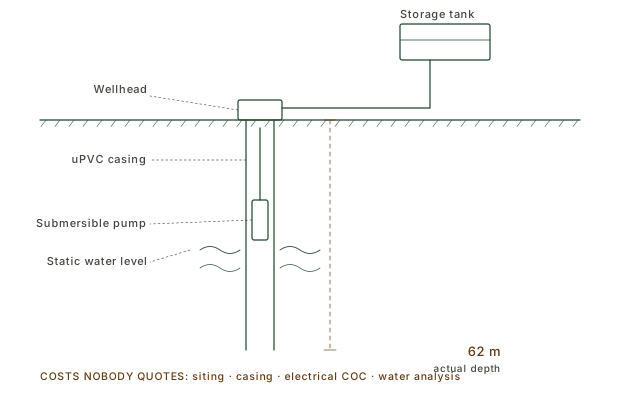
A borehole is the most reliable water source on most inland properties — but it is also the one with the highest variance in outcome. Two properties separated by a fence can sit on entirely different aquifers. One yields 3,000 litres per hour at 40 metres. The other yields 200 litres per hour at 120 metres, or nothing at all. No amount of pre-drilling research eliminates that uncertainty; a hydrogeological survey reduces it.
The first decision is whether to drill at all, and that depends on what a failure costs you relative to what success is worth. The second decision is what to do with the water once you have it — storage, pump selection, pressure, treatment, and backup when load-shedding kills the pump. Those decisions are more predictable than the drilling itself, and they are where most of the ongoing cost and complexity lives.
Yield depends on the aquifer type, the depth to water, and the borehole diameter and casing. In fractured rock — which is common across the Highveld and Bushveld — yield can be high but the borehole must intersect the fracture zone. In sedimentary aquifers yield is more predictable but often lower. Dolomitic ground, which covers a significant portion of Gauteng and the North West, introduces a third problem: the ground itself can be unstable, and drilling can trigger subsidence. A geophysical survey is not optional on dolomite.
Most boreholes use a submersible pump. The pump must be matched to the yield — a pump that draws faster than the aquifer recharges will run dry and burn out. In a load-shedding environment, the pump needs a power source that is independent of the grid: a dedicated solar pump controller feeding directly from panels, a battery backup, or a generator interlock. A borehole that cannot pump during an eight-hour outage is a partial solution, not a complete one.
For the full picture on what drilling and equipping a borehole involves — and what the process looks like from survey to commission — read What a borehole really costs in inland South Africa at water/what-a-borehole-costs.
| Aquifer type | Where common | Yield range | Key risk |
|---|---|---|---|
| Fractured rock | Highveld, Bushveld, Karoo | Very low to very high | Misses fracture zone |
| Sedimentary (alluvial) | River valleys, coastal plains | Low to moderate, consistent | Seasonal variation |
| Dolomitic | Parts of Gauteng, NW Province | Variable | Ground instability, sinkhole risk |
| Weathered basement | Limpopo, parts of Mpumalanga | Low to moderate | Depth to bedrock varies widely |
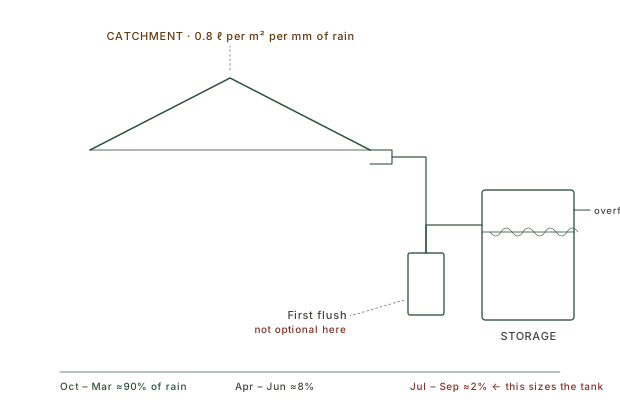
Rainwater harvesting is the simplest water source to set up and the one most people undersize. The calculation that matters is roof area multiplied by annual rainfall multiplied by a runoff coefficient, compared against daily demand multiplied by the number of days you need to bridge between meaningful rain events. In most inland parts of South Africa, that bridging gap is not the three or four dry weeks that a European system would be sized for — it is a dry season of five to seven months.
That single fact changes the maths completely. A 5,000-litre tank that is adequate in the UK is a week's supply in a dry Highveld winter. Sizing for South African conditions means either very large storage, a supplementary source, or an honest acceptance that rainwater here is a wet-season supplement rather than a primary supply.
Roof-harvested water picks up bird droppings, dust, insect debris, and atmospheric pollution. The first flush after a dry spell is the most contaminated. A first-flush diverter — a simple device that routes the first few litres of runoff to waste — removes most of the contamination before it reaches the tank. Without one, the water is usable for irrigation and toilet flushing but requires treatment before it is safe for drinking or cooking.
Gutters must be screened, tanks must be sealed against mosquitoes and light (algae cannot grow in the dark), and the overflow must be directed away from the foundation. These are not optional refinements — they are what separates a rainwater system from a standing water hazard.
In summer-rainfall regions — which is most of the interior — rain falls when demand from the garden is already partly met by rain on the soil. The dry winter is when irrigation demand peaks, and it is precisely when the tanks are not being refilled. A rainwater system that is not combined with a borehole or municipal top-up will run empty in August on almost any property in Gauteng, Limpopo, or Mpumalanga.
The article Sizing rainwater tanks for inland South Africa rainfall at water/rainwater-harvesting works through the sizing calculation in full, with regional rainfall figures and seasonal profiles.
Greywater is wastewater from basins, showers, baths, and laundry — everything except the toilet. In a typical household it is sixty to seventy percent of total wastewater volume, and most of it can be reused for irrigation or toilet flushing without treatment beyond basic filtration. That is water that would otherwise go down the drain, and on a property where water is a constraint it is one of the easier gains to make.
The gain is real but it is bounded. Greywater is not clean water. It contains soap, skin cells, food traces, and — depending on the household — cleaning chemicals that are toxic to plants. It cannot be stored for more than about 24 hours without beginning to smell and harbour pathogens. It cannot be used on vegetables that will be eaten raw without further treatment. Understanding what it can and cannot do is what stops a greywater system from becoming a source of disease or garden damage.
The simplest greywater system is a branched-drain system: gravity-fed from the bathroom, branching through perforated pipes beneath a mulch layer in the garden, with no pumping and no storage. It is cheap, legal for domestic use under current municipal by-laws in most jurisdictions, and effective for subsurface irrigation of trees and shrubs. Its limitation is that it cannot be stored, switched off, or directed to a toilet cistern.
More capable systems — those that filter, buffer, and redirect greywater to toilet cisterns or irrigation on demand — require a pump, a holding tank, and a level of filtration that brings them under the purview of local authority approval in some municipalities. The legal position varies by province and by local authority, and it changed when the National Water Act was amended. Checking with the relevant municipality before installing anything more than a branched-drain system is not bureaucratic caution — it is what prevents a system being ordered removed after installation.
The full treatment of what is legal, what is not, and how the different system types compare is in How a greywater system works and what the law requires at water/greywater-systems.
A constructed wetland is a shallow, planted bed through which wastewater flows slowly enough for plants, bacteria, and sunlight to strip out pollutants before the water returns to the environment or is reused. It is the most biological of the water treatment options, the least mechanically complex, and the one that degrades most gracefully when it is not perfectly maintained. It is also the one that requires the most land area and the most patience — a wetland beds in over two to three growing seasons before it reaches full treatment performance.
On a rural or semi-rural property, a constructed wetland can treat the greywater that a greywater system cannot handle — the kitchen sink, laundry, and anything with higher organic loading — and discharge effluent that is clean enough to use for subsurface irrigation or to recharge a dam. Combined with a greywater system for the simpler waste streams, it can close most of the water loop without a sewage connection or a septic tank.
Water enters the inlet end of the bed, flows horizontally or vertically through a gravel or crushed-stone substrate, and exits at the outlet. Reeds, bulrushes, or other water-tolerant plants grow in the substrate. Their roots create a zone of aerobic activity — where there is oxygen — immediately around them, and an anaerobic zone in the bulk of the substrate between root zones. Different groups of bacteria colonise each zone, and together they handle the range of pollutants in typical domestic wastewater: BOD (biological oxygen demand), suspended solids, nitrogen, and pathogens.
The plants themselves are secondary — the substrate and its bacterial community do most of the work. But the plants are not cosmetic: they oxygenate the root zone, take up nutrients, and provide the structural complexity that the bacterial community needs. A poorly planted or overgrown wetland treats less effectively. Harvesting the above-ground biomass once or twice a year — and removing it, not composting it in place — returns the system to working condition and prevents nutrient accumulation.
The critical design parameters are surface area (determined by hydraulic loading rate and treatment target), depth (typically 0.6–0.9 metres for a horizontal-flow system), and inlet/outlet design (which determines flow distribution and prevents short-circuiting). Getting any of these wrong produces a system that treats poorly and smells. Getting them right produces a system that is almost invisible in the landscape and requires an hour or two of maintenance per month.
The detail — including a worked sizing calculation for a four-person household — is in How a constructed wetland actually treats water at water/constructed-wetland.
| Type | Flow direction | Treatment strength | Odour risk | Area required |
|---|---|---|---|---|
| Horizontal subsurface flow (HSSF) | Horizontal through substrate | Good for BOD and solids | Low | Moderate to large |
| Vertical subsurface flow (VSSF) | Vertical, batch-loaded | Better for nitrification | Very low | Smaller than HSSF |
| Free water surface (FWS) | Surface flow, open water | Good for polishing treated effluent | Moderate if overloaded | Largest |
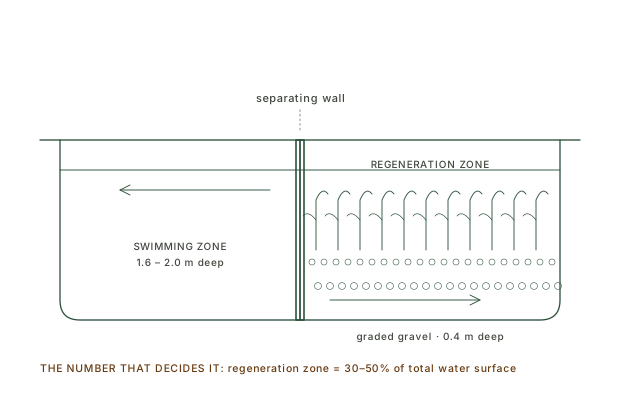
A natural swimming pool replaces chlorine with biology. The water is kept clean by a planted regeneration zone — typically a shallow, planted bay separated from the swimming zone by a submerged wall — through which the pool water circulates continuously. Algae are controlled by the aquatic plants competing for the same nutrients. Pathogens are managed by the same combination of UV light, plant uptake, and bacterial activity that works in a healthy natural water body.
The result, when the system is balanced, is water that is clear, skin-friendly, and free of the chemical load of chlorinated pools. It also does not corrode metal fittings, does not require the chemical management and safety storage that chlorine systems demand, and does not discharge anything to the stormwater system when it is backwashed or drained.
Most natural pool projects in South Africa start as conversions — a chlorine pool that the owner wants to move away from, whether for health reasons, the cost of chemicals, or the complication of chemical management during extended load-shedding. The conversion is not simply a matter of stopping the chlorine and adding plants. The balance of the regeneration zone relative to the swimming zone, the circulation rate, the substrate depth, and the plant selection all determine whether the water clears or turns green.
A converted pool that goes wrong is unswimmable, and restoring it after an algal bloom is harder than establishing the system correctly from the start. The order of operations — how to transition the system without losing water clarity during the changeover — is the most important technical question in a conversion. It is covered in detail in Converting a chlorine pool to a natural swimming pool at water/natural-pool-conversion.
A natural pool uses water differently from a chlorine pool. Evaporation losses are the same. Backwash losses are eliminated. But the regeneration zone is a living plant system, and in a dry climate with low humidity, evapotranspiration from the planted area adds to losses. A natural pool in an inland South African summer may lose marginally more water than a covered chlorine pool of the same surface area. In a water-constrained situation, that is a real consideration — not a reason to reject the option, but a number to account for in the water budget.
Almost everything published about water independence online was written for Germany, the UK, Australia, or the American Pacific Northwest — places with year-round rainfall, temperate summers, and functional municipal backup. The advice is often technically sound for those places and quietly wrong for here.
The differences are not marginal. They change the sizing, the sequencing, and sometimes the basic viability of a system.
Across the five parts of this subject, the same mistakes recur. They are not obscure errors — they are the predictable results of planning with international references and optimistic assumptions about South African conditions.
Guides
Each one names its sources, and says plainly where a figure could not be sourced.
Water
A drilling quote is a rate, not a total. Here is what sits between the two, why the depth is the variable that decides everything, and the sequence that stops you buying the wrong pump.
Water
A swimming pool filtered by plants instead of chemicals. What the regeneration zone has to do, how big it must be, and the arithmetic against ten years of chlorine and pump electricity.
Water
Our rain falls in six months and our dry season is brutal. The international sizing formulas assume neither, and following them will leave you with an empty tank in September.
Water
Reusing bath, basin, and laundry water is one of the quickest ways to cut municipal consumption — but the biology and the by-laws both have teeth. Here is what you need to understand before you connect anything.

Water
A constructed wetland turns biological waste into clean enough water to irrigate with — no chemicals, no power, and very little maintenance once established. The design that works in Europe needs adjusting before it works here.
From the journal
Dated write-ups from the journal that touch this pillar — what is being built, tested and costed right now.
The other six
Nothing on a smallholding is a closed system. These are the pillars this one touches most.
The Sunday Dispatch
What we are building, what we have sourced, and what it costs — with the supplier named and the quote dated. No affiliate padding, no doom, no filler.
One email every Sunday. Unsubscribe in one click, any time.