Water
Sizing rainwater tanks for inland South Africa rainfall
Our rain falls in six months and our dry season is brutal. The international sizing formulas assume neither, and following them will leave you with an empty tank in September.
The short answer
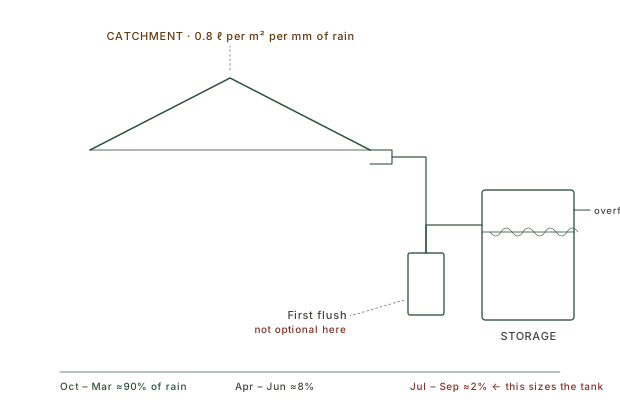
Roof catchment yields roughly 0.8 litres per square metre per millimetre of rain. On inland South Africa, where around 90% of annual rainfall falls between October and March, tanks must be sized against the dry-season deficit rather than annual totals. For most households that means far more storage than the standard formulas suggest — and a first-flush diverter is not optional.
Rainwater is the cheapest water you will ever have, and in inland South Africa it arrives almost entirely in one half of the year.
That single fact makes most of what is written about tank sizing wrong for us. The standard formulas are built for temperate climates with rain spread through the year, where a modest tank buffers a fortnight's gap. Ours has to carry a household across six months.
The catchment arithmetic
Roughly 0.8 litres per square metre of roof, per millimetre of rain. The 0.8 rather than 1.0 accounts for splash, evaporation and what the first flush takes out.
So a 150 m² roof in a month with 100 mm of rain yields about 12,000 litres. That number is usually a pleasant surprise, and it is also where people stop reading — because the interesting question is not how much you collect, it is how much you can keep.
| Period | Share of annual rain | Implication |
|---|---|---|
| October – March | ≈ 90% | Collection is easy. Storage is the constraint. |
| April – June | ≈ 8% | Drawing down. Nothing meaningful arriving. |
| July – September | ≈ 2% | The deficit. This is what sizes the tank. |
| Size against | the dry-season deficit, never the annual total |
How to size it properly
- Work out your genuine daily demand for whatever the tank is for — garden, toilets, laundry. Do not size for the whole household unless you intend to plumb the whole household.
- Multiply by the number of dry days you need to cover. On inland South Africa, plan for 120 days from the last useful rain.
- Compare that to what your roof can deliver in the wet months. Usually collection is not the limit — storage is.
- Then buy the largest tank the site and budget allow, because the marginal cost per litre falls steeply with size.
A 2,500-litre tank sounds substantial and is roughly a fortnight of modest garden irrigation. A 10,000-litre tank is a different proposition entirely, and costs nothing like four times as much.
What to plumb it to first
Garden, then toilets, then laundry — in that order, because that is the order of decreasing tolerance for imperfect water and increasing plumbing cost.
Drinking water is a separate conversation involving filtration and testing, and we would not plumb roof water to a tap without a SANS 241 analysis first. Roofs are not clean.