Security
Solar security lighting that still works in year three
Almost every cheap solar security light fails inside eighteen months, and always for one of three reasons. None of them is the panel.
The short answer
Cheap solar security lights fail for three reasons: an undersized lithium cell that dies after 300–400 cycles, a sealed unit that cannot be serviced, and a PIR sensor that degrades in UV. A serviceable unit with a replaceable 18650 cell and a separate panel costs 3–4× more and lasts 5–8 years instead of one.
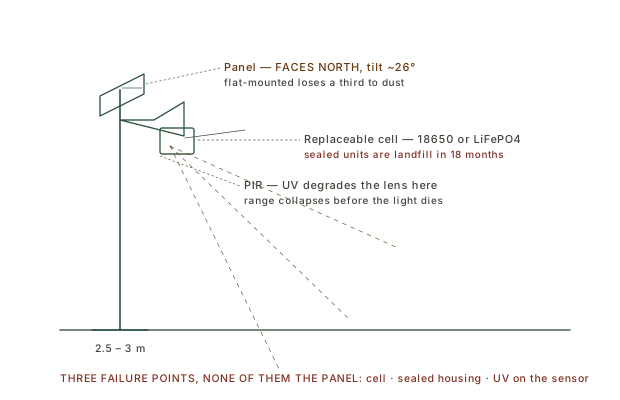
Perimeter lighting is the cheapest layer of security there is, and solar removes the one thing that makes it expensive to install: the trench.
It is also a category almost entirely occupied by products designed to fail. Ours is the third set, and the first two taught us what to look at.
Why the cheap ones die
The cell, not the panel. A cheap solar light contains a lithium cell of a couple of amp-hours, cycled fully every single night. Three hundred to four hundred full cycles is roughly a year. The panel will outlive the light by a decade; the battery will not see a second winter.
Sealed construction. If you cannot open it, you cannot replace the cell, and a sealed unit with a dead battery is landfill. This is not accidental design.
UV on the sensor. The PIR lens on cheap units is unstabilised plastic. A inland South Africa year of direct sun crazes it, and detection range collapses long before the light stops working — so it appears fine and simply stops triggering.
What to look for
- A separate panel on a cable. All-in-one units force you to mount the light where the sun is, rather than where the light is needed. Those are rarely the same place.
- A replaceable cell, ideally a standard 18650 or LiFePO4 pack, behind screws rather than glue.
- A stated IP rating, IP65 or better, and a metal or UV-stabilised housing.
- A PIR with an adjustable lux threshold, so it does not trigger at dusk and flatten the battery before midnight.
- A warm colour temperature, 3000K, not 6500K. Cold white destroys your own night vision and annoys neighbours far more than it deters anyone.
Mounting, which matters more than the product
Panels face north in the southern hemisphere. This is the single most common installation error and it halves output — plenty of people mount them facing the road because that is where the light points.
Tilt roughly to your latitude. On inland South Africa that is about 26 degrees from horizontal, which also sheds dust. A flat-mounted panel accumulates a film that costs you a third of your generation inside a season.
Mount lights at 2.5 to 3 metres. Higher gives coverage but weakens PIR detection; lower is easy to interfere with.
Where lighting sits in the layers
Lighting is a deterrent and a detection aid. It is not a barrier, and treating it as one is how people end up with a very well-lit break-in.
The useful sequence is: make the approach visible, make the boundary slow, make entry noisy, and make sure someone is notified. Lighting does the first job cheaply and does nothing at all for the other three.
And be honest about what you are lighting for. A light that triggers forty times a night on moving vegetation is training you to ignore it.