Security
Electric fencing on a smallholding: what it costs and what it does not do
Per-metre costs for a real perimeter, the difference between a security and an agricultural energiser, and the certificate most owners have never heard of.
The short answer
Electric fencing is priced per metre installed, and the two things that move that price most are whether the run is wall-top or freestanding and whether the energiser is security-grade or agricultural — they are not interchangeable. Security energisers must comply with SANS 60335-2-76, and any installation requires an Electric Fence System Certificate of Compliance on transfer of the property under the Electrical Machinery Regulations. Ask for that certificate in writing before you accept a quote.
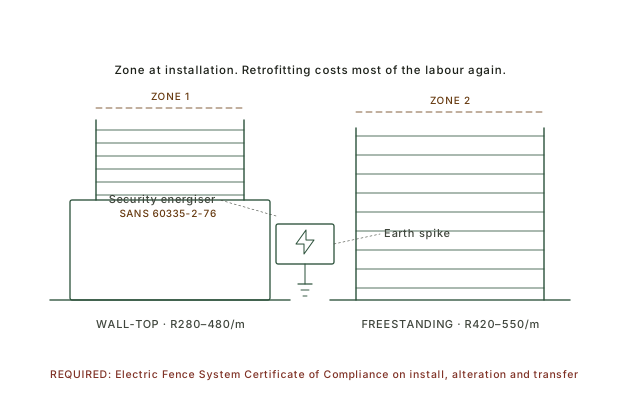
Electric fencing is the most-searched security term in this country after alarms and cameras — electric fence returns 3,600 searches a month — and it is also the one where the gap between what people buy and what they need is widest.
On a smallholding perimeter the numbers get large quickly, and the decisions you make in the first hour determine whether the system is useful or simply expensive.
Security or agricultural?
These are different products and they are not interchangeable.
An agricultural energiser is built to keep livestock in. It delivers a lower-energy pulse, it tolerates vegetation contact, and it is cheap. It is entirely unsuitable as a security barrier and it will not comply with the standard.
A security energiser is built to deter a person and to alarm on tamper, cut or short. It is monitored, zoned, and it must comply with SANS 60335-2-76. If someone quotes you an agricultural unit for a security application, that is the end of the conversation.
The certificate nobody mentions
Under the Electrical Machinery Regulations made in terms of the Occupational Health and Safety Act 85 of 1993, an electric fence system requires an Electric Fence System Certificate of Compliance, issued by a registered electric fence installer.
It is required when a system is installed or altered, and it is required on transfer of the property. A great many owners discover this at the point of sale, when the conveyancer asks for it and the existing installation turns out not to comply.
Ask for the certificate at installation. Keep it with the property file. It is not optional and it is not expensive at the time — only afterwards.
What electric fencing does not do
It does not stop anyone. It delays them, it hurts, and — if it is monitored — it tells you. That is the whole function, and it is a valuable one, but it is not a wall.
An unmonitored electric fence is a fence that will be defeated quietly. The energiser is not the product; the notification is. If the system is not integrated to something that raises an alarm with a person, you have bought a deterrent and not a detection system.
And vegetation is the enemy of the whole thing. A branch on a strand loads the line, drops the pulse and generates false alarms until you stop believing them. Perimeter clearance is a maintenance job forever, not a task you complete.
Where to spend first
If the budget will not stretch to a full perimeter — and on most smallholdings it will not — the honest priority order is lighting, then the approach and gate, then the house envelope, then the perimeter.
A lit, visible approach and a solid, monitored house envelope will do more for you per rand than 400 metres of energised wire that nobody is watching.